How do you make a company into a LTC (Look-Through Company)? It’s a genuinely straightforward process once the company itself exists. This guide walks through the actual election specifically. If you’re starting from scratch and need the full journey — from forming the company through to ongoing compliance — see our complete guide to how to set up an LTC instead.
Everyone who owns a look-through interest in the company must sign the form for it to be valid. That’s not just the majority shareholder.
An LTC can have a maximum of 5 owners.
There might be tax to pay on changing a standard company to an LTC
If your company was previously an LTC and stopped being one, it can’t re-elect LTC status until two full income years have passed.
The form can be filed electronically through myIR, or posted directly to IRD.
Step 1: Incorporate the Company First
The election only applies once the company itself exists. This is a separate step from making it an LTC. If you haven’t incorporated yet, we can help with that directly before moving on to the LTC election itself.
The income year field trips people up. Accountants generally refer to the financial year as the one ending the following 31 March. So if today’s date falls before 31 March, you’re likely in the financial year ending that coming March. If it falls just after 1 April, you’ve moved into the next one. Getting this field wrong is a common, easily-avoided mistake — double-check which financial year you’re actually electing into before submitting.
Everyone with a look-through interest must sign. This includes a trustee, director, or an agent with proper authority to sign on an owner’s behalf. It’s not just whoever happens to be the majority shareholder. If an owner is under 18 or otherwise can’t legally sign, a guardian, power of attorney, or legal representative needs to sign in their place.
You’ll need, for each owner:
Full name
IRD number
Then sign and date the form. Once the election is filed and accepted, your company also takes on the ongoing compliance obligations that come with running an LTC. This election is the starting point, not the end of the process.
Step 3: Submit the Form
You can file the IR862 electronically through myIR, which is generally the fastest and most reliable option, or post it directly to IRD. If you’re posting, check IRD’s current mailing address for the specific form, since postal addresses do change from time to time. IRD’s own IR862 page(opens in new tab) will have the current details. Alternatively, send the completed form to us and we’ll handle submission for you.
Two Restrictions Worth Knowing About
Maximum of 5 owners. An LTC can’t have more than five owners at election time — read the form’s own instructions carefully if your company has multiple shareholders, trusts, or other entities involved.
A two-year stand-down after ceasing LTC status. If your company was previously an LTC and stopped being one, it can’t re-elect LTC status again until two full income years have passed. That applies whether it stopped by choice or because it no longer qualified. For example, a company that stopped being an LTC in the 2024 income year can’t re-elect until the 2027 income year at the earliest. This is worth checking carefully if your company has a mixed LTC history.
A “Gotcha” To Be Aware Of
You need to calculate the tax cost – if any – of the company becoming an LTC. In brief, the tax process comes down to four things:
the election must be in before the income year starts,
any old losses are extinguished,
each owner is taxed on a deemed dividend in year one, and
the company then files an IR7 each year.
The process
The source material for this is the IRD LTC guide (IR879), parts 2, 3 and 6:
Check eligibility. The company must be NZ tax resident, with five or fewer look-through counted owners (related owners count as one), and only natural persons, trustees or other LTCs as shareholders. It can’t be a flat-owning company.
Check the stand-down. If the company was an LTC before, it can’t re-elect for the year it stopped or the two following years.
File the IR862 before the income year starts. For a company that has already traded, the election applies from the start of the income year after IRD receives it. An election received after the start of the intended year is invalid. IRD may accept a late or invalid election only in exceptional circumstances. A standard-balance-date company must therefore file by 31 March to become an LTC from 1 April.
Get the signatures right. Every owner of a look-through interest at the election date signs, plus the director or an authorised agent. The form must name the income year. A non-active company also needs an IR434.
Old losses are extinguished. Any loss balance from years when the company wasn’t an LTC is cancelled and can’t be used in the first LTC return.
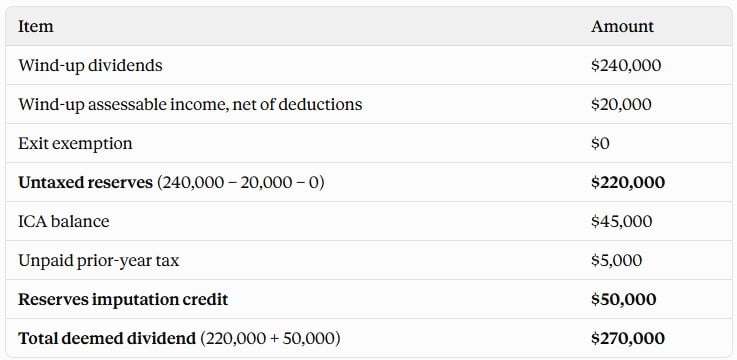
Each owner is taxed on a deemed dividend on day one. Each owner is treated as receiving income on the first day of the first LTC year. It is their share of the company’s untaxed reserves, plus a reserves imputation credit, calculated as if the company were wound up. It is declared in the owner’s own return for that year, as a dividend with imputation credits attached.
Ongoing. The LTC files an IR7, owners declare their shares, and the company stays responsible for GST, PAYE, FBT and RWT.
The first-year formula
This formula applies to 2017-18 and later years:
Untaxed reserves = dividends − assessable income − exit exemption
Owner income = (untaxed reserves + reserves imputation credit) × the owner’s share
The guide mentioned above defines the terms as follows:
Dividends are the taxable dividends that would arise if the company were wound up immediately before the election.
Assessable income is what the company would derive on a wind-up, net of winding-up deductions. This includes depreciation recovered, bad debts and losses on sale of assets.
Exit exemption only applies to a company that was previously an LTC.
Reserves imputation credit is the ICA balance, plus unpaid prior-year income tax, less refunds due, capped at the 28:72 ratio to the untaxed reserves.
Worked example
Let’s see what this looks like in practice.
Meilin owns 60% and Ravi owns 40% of Kauri Rentals Limited. It is an ordinary NZ company with two rentals, a 31 March balance date, and has never been an LTC. They want it to be an LTC from 1 April 2027.
Timing: Both owners and the director sign the IR862 naming the 2027-28 income year. IRD must receive it by 31 March 2027. The company’s $18,000 of unused tax losses are extinguished on election.
Assumed inputs. The first three are illustrative figures your accountant would calculate on a deemed wind-up.
If we assume a 33% marginal (personal) tax rate on the whole dividend – for the sake of keeping things simple – the individual tax might look something like this:
Both declare these amounts in their 2028 returns. From then on, per IRD, they can draw down or distribute the reserves without further tax. The credits cover less than the owners’ marginal rates, which is why a top-up is payable. Be aware that LTC income can also bring provisional tax obligations.
If You’re Buying Property Through the LTC
If the purpose of the conversion is to purchase a rental property, we’d generally also recommend completing a shareholders’ resolution documenting the purchase and its purpose. Talk to us about a sample resolution suited to your specific situation. A generic template may not reflect current requirements.
Checklist
✅ Confirm the company is fully incorporated before attempting the LTC election
✅ Work out the tax cost of the change
✅ Double-check the financial year field on the IR862 — this is the most common mistake
✅ Get signatures from everyone with a look-through interest, not just the majority shareholder
✅ Confirm your company has five or fewer owners
✅ If your company was previously an LTC, check the two-year stand-down period doesn’t apply
✅ File through myIR where possible, or confirm IRD’s current postal address before posting
Common Questions
Does the IR862 need everyone’s signature, or just the majority shareholder’s? Everyone with a look-through interest needs to sign for the election to be valid — this includes trustees, directors, or authorised agents acting for an owner.
Can I convert a company to an LTC at any time? Generally, the election needs to be filed by the due date for the relevant income tax return, so timing matters. For an existing company, the IRD guide (IR879) says it must be received before the income year starts, and a late one is invalid. Talk to us if you’re unsure which income year applies to your situation.
What if my company was an LTC before and stopped being one? You’ll need to wait two full income years after ceasing LTC status before you can re-elect. This applies regardless of the reason it stopped.
Is there a limit on how many owners an LTC can have? Yes — a maximum of five. The exact wording in law is “five or fewer look-through counted owners” test, where related owners count as one and trusts are looked through.
Is there a cost to convert my company to an LTC? IRD do not charge a fee; it is simply a case of completing the correct form and sending it to them. However, there might be tax to pay on conversion. Do your sums carefully to avoid getting stung with a huge tax bill.
Summary
Converting an existing company into a Look-Through Company means completing and filing IRD’s IR862 election form, with everyone holding a look-through interest signing it — not just the largest shareholder. Keep the five-owner limit and the two-year re-election stand-down in mind. Get the financial year field right, and file through myIR where you can for the fastest processing. If you’re converting specifically to buy a rental property, a proper shareholders’ resolution is worth having alongside the election itself.
Talk to EpsomTax.com About Your LTC Election
Getting the IR862 filed correctly the first time avoids delays and unnecessary back-and-forth with IRD. Contact EpsomTax.com and we can quote to complete and file this for you, along with any shareholders’ resolution your situation needs.