
CHANGES TO FINANCIAL REPORTING REQUIREMENTS FOR SMES
Financial Reporting Act. What is that? Many small business owners assume financial reporting requirements only affect large corporations. Changes introduced under the Financial Reporting Act 2013 (opens in new tab) did significantly reduce statutory obligations for thousands of New Zealand SMEs, LTCs, and family-owned companies. “Reduced” isn’t the same as “eliminated,” though. This guide explains what actually changed, what still applies to you, and clears up a threshold that’s commonly stated incorrectly.
30-Second Read
- The Financial Reporting Act 2013 removed the requirement for most SMEs to prepare full NZ GAAP-compliant financial statements purely because legislation demanded it.
- It did not remove the practical need for financial statements. IRD, banks, shareholders, and directors all still require reliable financial information.
- Most SMEs now prepare special purpose financial statements instead. They’re simpler, but still need to be accurate and properly maintained.
- A company only faces the full “large entity” reporting burden if it crosses specific size thresholds. Currently that’s $66 million in assets or $33 million in revenue for a NZ company, not the much lower figures sometimes quoted.
- Directors’ duties under the Companies Act, including solvency assessments, are completely unaffected by any of this.
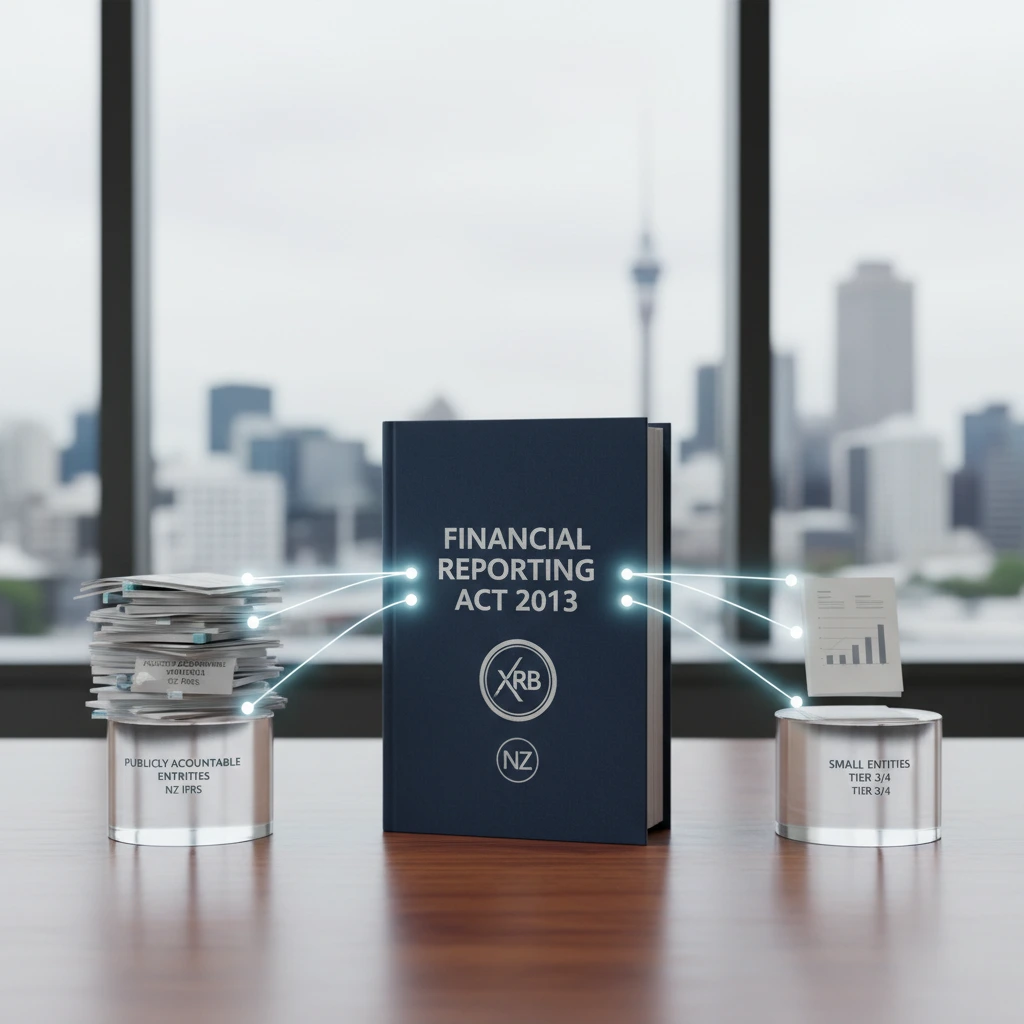
What the Act Actually Changed
Before the 2013 reforms, many companies needed to prepare financial statements complying fully with NZ GAAP(opens in new tab) — extra accounting work, more disclosure, and real compliance cost, often for limited practical benefit to a small, privately-owned business.
The Act removed that blanket requirement. Entities that don’t meet the definition of a “large” entity generally no longer need to prepare general-purpose financial statements solely because the law demanded it. That’s a genuine simplification. Plenty of business owners read it as “I don’t need financial statements at all,” though — which isn’t what it says.
Do SMEs Still Need Financial Statements? Yes.
Reliable financial statements remain essential, regardless of what the law technically requires, because real stakeholders still need them:
- Inland Revenue still expects you to maintain proper accounting records and support what’s in your tax return. Following the reforms, IRD’s guidance confirmed businesses would generally keep preparing special-purpose statements using historical-cost, double-entry, accrual-based accounting. They just wouldn’t necessarily need to meet full NZ GAAP standard.
- Banks and lenders assess profitability, debt levels, cash flow, and asset position before approving finance. Without financial statements, none of that can be demonstrated.
- Shareholders, even a sole shareholder, need reliable information to understand profitability, asset growth, and dividend capacity.
- You, as the owner, need to know whether the business is actually profitable. Can it afford new equipment? Is it financially stable? These are hard questions to answer from memory alone.
The legal requirement changed. The practical need didn’t.
What Actually Defines a “Large” Entity
This is the detail most often stated wrong. Under section 45 of the Financial Reporting Act 2013(opens in new tab), a New Zealand company is “large” if, in each of the two preceding accounting periods, it meets at least one of the following:
- Total assets exceeding $66 million, or
- Total revenue exceeding $33 million
For an overseas company (or a NZ subsidiary of one), the thresholds are lower: $22 million in assets or $11 million in revenue. There’s no employee-count test in this definition at all.
These figures took effect from 1 January 2022, replacing lower thresholds that applied before then. Most SMEs, and virtually every property investor, sit well below these numbers.
Special Purpose Financial Statements
Most SMEs now prepare special purpose financial statements rather than full general-purpose ones. These focus specifically on what IRD, banks, shareholders, and directors actually need, typically including:
- Balance sheet
- Profit and loss statement
- Comparative figures
- Accounting policies
- Supporting schedules and tax reconciliations
- Related-party disclosure schedules
They’re more practical and cost-effective than full NZ GAAP reporting, without sacrificing the accuracy that actually matters.
What About LTCs?
Many property investors operate through a Look-Through Company. The 2013 reforms caused real confusion here — some LTC shareholders assumed the changes meant no annual accounts were needed at all. LTCs still need reliable financial information for shareholder reporting, tax return preparation, IRD compliance, asset tracking, and loan applications. The reporting framework may be simpler, but the underlying need for proper accounting hasn’t gone anywhere.
Directors’ Duties Are Completely Unaffected
The Financial Reporting Act changes didn’t touch directors’ duties under the Companies Act 1993. Directors still need to maintain proper accounting records, understand the company’s financial position, and ensure it can meet its obligations. This connects directly to solvency assessments. A director genuinely can’t assess solvency on reasonable grounds without accurate financial records behind them — reduced statutory reporting requirements don’t reduce this obligation at all.
Common Misunderstandings
“I don’t need an accountant anymore.” Most businesses still need help with year-end accounts, tax planning, GST compliance, and cash flow forecasting. The focus shifted toward special-purpose reporting; the need for sound accounting didn’t disappear.
“I only need records for tax.” Tax compliance is only one part of financial reporting. Good financial information also supports business planning, financing, and governance.
“My accounting software is enough.” Software makes record-keeping easier. It doesn’t identify errors, interpret results, or optimise your tax position, though. Professional review remains genuinely valuable.
Checklist
- ✅ Confirm your actual size against the correct current thresholds — $66m assets or $33m revenue for a NZ company — not outdated or incorrect figures
- ✅ Keep preparing special purpose financial statements even if you’re not legally required to prepare full NZ GAAP accounts
- ✅ Maintain proper records year-round, not just at year-end, given how much banks and IRD still rely on them
- ✅ Remember directors’ duties, including solvency assessments, are entirely unaffected by these reforms
- ✅ If you operate through an LTC, don’t assume the reforms removed your need for annual accounts
Common Questions
Does this mean small companies don’t need financial statements at all? No. The legal requirement to prepare full NZ GAAP statements was reduced for smaller entities. The practical need for reliable financial statements remains, though, for tax, lending, and governance purposes.
What’s the actual threshold for being a “large” company? $66 million in assets or $33 million in revenue for a NZ company, tested over the two preceding accounting periods. That’s significantly higher than some older or incorrect figures still circulating.
Do LTCs still need annual accounts? Yes. LTCs still need reliable financial information for tax returns, IRD compliance, and loan applications, regardless of the simplified reporting framework.
Does this affect my duties as a director? No. Directors’ duties under the Companies Act, including the obligation to assess solvency properly, are completely separate from these financial reporting changes.
Summary
The Financial Reporting Act 2013 genuinely reduced the statutory reporting burden for most SMEs, removing the requirement to prepare full NZ GAAP-compliant financial statements purely because legislation demanded it. What it didn’t do is remove the practical need for reliable financial information. IRD, banks, shareholders, and directors all still depend on it, and directors’ duties under the Companies Act remain entirely untouched. Most SMEs now prepare special purpose financial statements instead: simpler, more cost-effective, and still genuinely useful, provided they’re properly maintained.
Talk to EpsomTax.com About Your Reporting Obligations
Getting the right reporting framework in place — one that satisfies IRD, your bank, and your own decision-making needs, without unnecessary compliance cost — is exactly what we help clients with. Contact EpsomTax.com to make sure your financial reporting is set up properly for your specific situation. We work with New Zealand SMEs and property investors every day. We can help you get genuinely useful financial statements without paying for compliance you don’t actually need.
Pages
Useful Links
Services
Contact Details
Phone: 0800-890-132
Email: mytaxinfo@epsomtax.com
Fax: +64 28-255-08279
EpsomTax.com © 2026